C-Section Rates at Metro Detroit Hospitals: What the Numbers Really Mean
C-Section Rates at Metro Detroit Hospitals: What the Numbers Really Mean
Updated September 2026

If you're pregnant and planning to give birth in a Metro Detroit hospital, you may have wondered: What is the C-section rate at my hospital?
That's a fair question.
But there's more to these numbers than simply finding the hospital with the lowest percentage.
As a Detroit-area doula and childbirth educator, I want families to understand what these numbers actually mean, what they don't mean, and how to use them when making decisions about their birth.
First, Let's Talk About What These C-Section Rates Actually Measure
The numbers below come from The Leapfrog Group's 2026 hospital maternity-care data.
This is important: these are not overall hospital C-section rates.
Leapfrog measures cesareans among a specific group of birthing people: first-time mothers giving birth to one baby, at full term, with the baby in a head-down position.
You may see this referred to as the NTSV C-section rate:
Nulliparous – first birth
Term – 37 weeks or later
Singleton – one baby
Vertex – baby is head down
This group is studied because these pregnancies generally have fewer reasons for a planned cesarean.
Leapfrog's current standard is an NTSV C-section rate of 23.6% or lower.
2026 C-Section Rates at Metro Detroit Hospitals
Here are some of the current NTSV cesarean rates reported by Leapfrog for hospitals serving Detroit and Metro Detroit:
Corewell Health William Beaumont University Hospital – Royal Oak
25.6%
Henry Ford Providence Southfield Hospital
25.8%
Corewell Health Farmington Hills Hospital
25.9%
Trinity Health Ann Arbor Hospital
26.7%
Trinity Health Livonia Hospital
26.8%
Declined to Report
University of Michigan Health – Michigan Medicine
27.1%
Henry Ford Providence Novi Hospital
27.1%
Corewell Health Beaumont Grosse Pointe Hospital
27.5%
Henry Ford Health West Bloomfield Hospital
28.4%
Corewell Health Dearborn Hospital
28.7%
Henry Ford Hospital – Detroit
34.0%
These numbers can change from year to year, which is why I recommend checking the current Leapfrog data when you're researching hospitals.
So Does a Lower C-Section Rate Mean a Hospital Is Better?
Not necessarily.
This is where I want families to be careful.
A C-section rate gives us useful information, but it doesn't tell the whole story about a hospital. Hospitals don't all care for the same population. Some hospitals receive more medically complex pregnancies or referrals from other facilities. Some have higher-level maternal or neonatal care. Different hospitals also have different provider groups, patient populations, policies and approaches to labor management.
The number also doesn't tell you what happened during an individual person's labor. So I wouldn't choose a hospital based on one percentage. I would use the number to start asking better questions.
Detroit's Numbers Deserve Attention Too
Hospital statistics aren't the only numbers worth looking at.
Michigan's 2024 vital statistics show that 34.2% of births among Detroit residents were cesarean births, compared with 32.4% statewide.
Among births classified as low-risk, cesareans accounted for 29.7% of Detroit resident births, compared with 28.2% statewide.
That doesn't tell us why each cesarean happened. It does tell us that cesarean birth is an important part of the conversation about maternal health in Detroit.
And for me, the question isn't simply, "How do we get the number down?"
The better question is:
Are people receiving the right intervention at the right time, for the right reason, with informed consent and respectful care?
Sometimes a cesarean is absolutely necessary and lifesaving.
The goal isn't to avoid cesareans at all costs.
The goal is to prevent unnecessary interventions while making sure people who truly need surgical birth have access to it.
Your Provider Matters Too
Here's something families don't always realize:
You don't really give birth with a hospital.
You give birth with a provider or provider group inside a hospital.
Two people can deliver at the same hospital and have completely different experiences depending on their provider, the circumstances of their pregnancy, who is on call, how their labor unfolds and the decisions made along the way.
That's why I encourage families to research the hospital and talk directly with their OB or midwife.
Ask questions before you're in labor.
Questions to Ask Your OB or Midwife
You have every right to ask your provider how they approach birth.
Here are some questions I encourage families to bring to prenatal appointments:
What is your primary C-section rate?
What are the most common reasons you recommend a C-section?
How do you approach induction when there isn't an immediate medical emergency?
How long do you typically allow someone to labor before diagnosing failure to progress?
How do you support movement and position changes during labor?
Can I eat or drink during labor if I'm low-risk?
Do you support intermittent or wireless monitoring when appropriate?
How do you approach pushing?
Do you support different pushing positions besides lying on the back?
Do you support VBAC? If so, under what circumstances?
And one of my favorite questions:
"If everything is healthy with me and my baby, how do you support physiologic birth?
Pay attention to the answer.
Induction Matters in This Conversation
Cesareans don't happen in isolation.
When you're researching a hospital or provider, it's also worth understanding how they approach induction, cervical exams, fetal monitoring, pain management, movement during labor and time limits placed on labor.
An induction does not automatically mean you'll have a C-section.
But induction changes the way labor is managed, and you deserve to understand what is being recommended, why it's being recommended, what the alternatives are and what happens if you choose to wait.
That's informed consent.
Birth Education Matters
This is one reason I'm so serious about childbirth education.
You shouldn't be learning words like induction, Bishop score, fetal monitoring, Pitocin, cervical dilation, epidural, assisted delivery and cesarean for the first time while you're in labor.
That's a hard time to learn.
Understanding birth before labor gives you time to ask questions, understand your options and decide what matters to you.
Education doesn't guarantee a particular birth outcome.
It gives you something just as important: The ability to participate in your own care.
What About Midwives?
Metro Detroit families also have access to Certified Nurse-Midwives in several hospital systems, along with birth-center and home-birth midwives.
Midwifery care may be worth exploring if you're interested in physiologic birth and a different model of maternity care.
I've created a separate resource to help families find Black and BIPOC midwives practicing throughout Metro Detroit:
Read: Black & BIPOC Midwives in Metro Detroit: 2026 Directory
That directory includes hospital-based Certified Nurse-Midwives, birth-center midwives and community/home-birth midwives.
What About Doulas?
A doula doesn't replace your doctor or midwife and doesn't make medical decisions for you.
My role as a doula is different.
I help you prepare.
We talk about what's happening in your body, labor positions, comfort measures, informed decision-making, questions to ask your medical team and what your options may look like if labor doesn't go according to the original plan.
During labor, I provide continuous physical, emotional and informational support.
The goal isn't to fight the hospital.
The goal is for you to understand what's happening and remain part of the decisions being made about your body and your baby.
Birth Data Is Part of Detroit's Birth Story
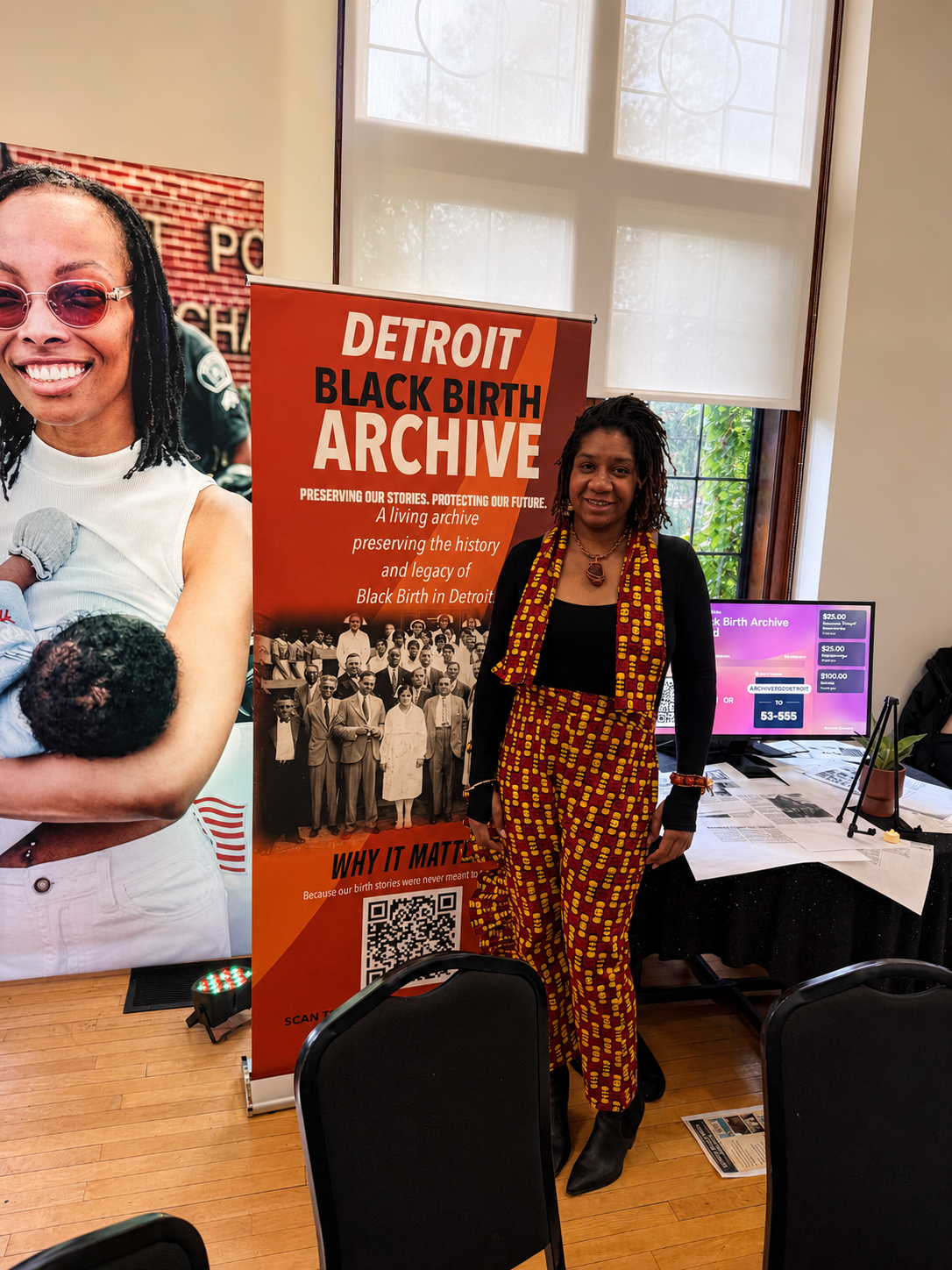
Through the Detroit Black Birth Archive, I'm documenting the history of Black birth, maternal health, hospitals, midwives, physicians, doulas and families in Detroit.
Today's maternal-health statistics are part of that history too.
Years from now, people should be able to look back and understand not only where Detroit families gave birth, but what maternity care looked like, who provided that care and what families experienced.
Preserving Black birth history means documenting the past.
It also means paying attention to what is happening right now.
The Bottom Line
C-section rates are worth knowing.
But don't let one number make your decision for you.
Look at the data. Learn about your hospital. Learn about your provider. Ask questions. Take childbirth education. Understand your options.
And remember that a cesarean isn't automatically a bad birth.
Sometimes surgery is necessary. Sometimes plans change. Sometimes birth takes a completely different direction than anyone expected.
What matters is that you are treated with dignity, given accurate information, included in decisions and supported throughout your birth.
You deserve to understand your care.
Sources & Data Note: Hospital C-section rates in this article come from The Leapfrog Group's 2026 maternity-care reporting. Leapfrog's cesarean measure applies specifically to first-time mothers with a single, full-term baby in the head-down position and should not be interpreted as a hospital's overall cesarean rate.
Detroit and Michigan population statistics come from Michigan Department of Health and Human Services 2024 vital statistics.
Hospital data and maternity services can change. This article was last reviewed and updated in September 2026.